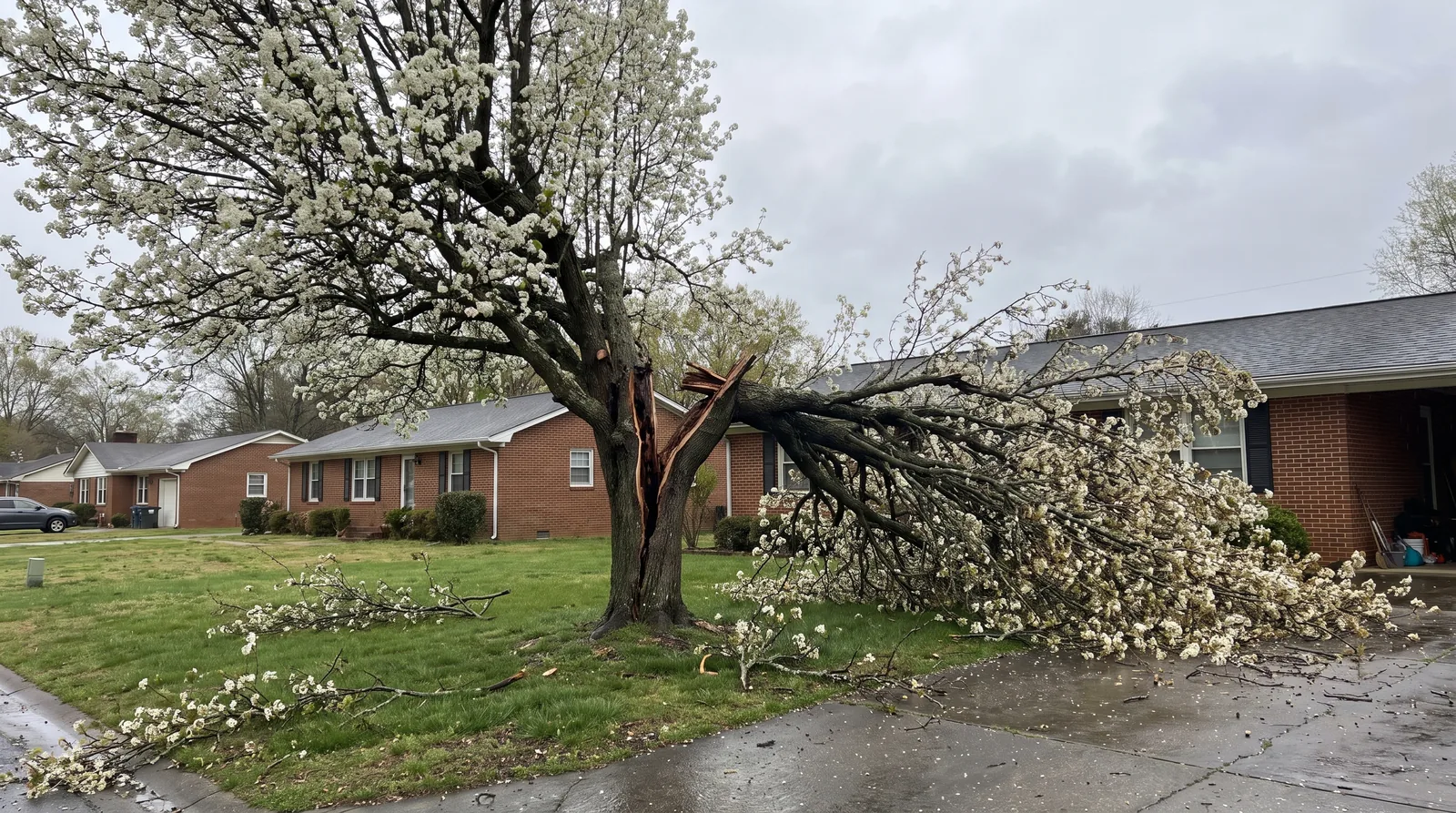
Why it was everywhere
The Bradford pear is a cultivar of the Callery pear, an Asian species brought to the U.S. in the early 1900s. It was released in the 1960s as the perfect street and yard tree — cheap, fast, tidy, white flowers in March, red leaves in fall, no fruit to speak of. Developers planted it in front of every house in Moss Creek, Christenbury, the early Highland Creek phases and the Harrisburg subdivisions along Rocky River Road. Nurseries sold it by the thousand.
Why it splits
Every major limb on a Bradford pear grows from the same point on the trunk at a tight, upright angle, with bark trapped between the limbs instead of wood — what arborists call included bark. Those unions are the weakest points on the tree, and pruning can't fix them because the structure was built in at the nursery. Snow load, ice or a strong wind opens one, and a third of the crown comes down at once. It typically happens between 15 and 25 years of age — which is where most Cabarrus County pears are right now. The December 2002 and February 2014 ice storms split them by the thousand.
Why it's invasive
Bradford pears can't pollinate themselves, but they cross freely with other Callery pear cultivars — and every 1990s subdivision has several. The result is fruit that birds eat and spread, and the seedlings revert to the wild type: thorny, dense, fast, and able to take over a fence line, a creek bank or an old field in a few years. The thorns run one to four inches and will puncture a tractor tire. Walk any tributary of the Rocky River in early March and the white-flowered thickets you see are Callery pear crowding out everything native. It leafs out earlier than native trees, shading them, and it supports almost none of the insects that native birds need to raise young.
The NC Bradford Pear Bounty
NC State Extension Forestry runs the bounty with the NC Forest Service, the NC Urban Forest Council and the NC Wildlife Federation. Homeowners who remove a Bradford pear from their property can receive a free native replacement tree — one per pear removed, up to five per household — at regional events, with 10 to 15 native species to choose from. You pre-register on the program's website, cut the tree (the program doesn't cover removal), and bring before-and-after photos to the event. Events have run across the state since 2022; check the schedule for Charlotte-area dates each spring and fall. We take the photos when we remove one.
What to plant instead
Similar size with spring flowers: serviceberry (white flowers, edible berries), eastern redbud (pink, early), fringe tree (fragrant white), flowering dogwood in part shade, or a native crabapple. For real shade: white oak, willow oak, black gum (best fall color in the Piedmont), red maple or American hornbeam. All of them feed birds and pollinators, hold up in ice, and won't seed the creek.
Common questions
Is the Bradford pear banned in North Carolina?
No — as of 2026, North Carolina hasn't banned sales, though South Carolina, Ohio and Pennsylvania have. The bounty program is the state's approach. Many HOAs have dropped it from their approved lists.
My Bradford pear looks healthy. Should I still remove it?
A healthy 20-year-old Bradford pear is a healthy tree with a structural time bomb built in. If it's over the driveway, the car or the sidewalk, replacing it on your schedule beats replacing it after it splits. If it's in the open and you love the flowers, keep it and expect it to fail eventually.
Will the stump grow back?
Aggressively, and the sprouts are the thorny wild type. Grind the stump and treat the root sprouts. If wild seedlings have already spread along your fence line, cut them and treat the stumps in the same visit.
How much does it cost to remove a Bradford pear?
$300 to $750 for a single tree with open access, $500 to $1,000 over a driveway or fence, and $900 to $3,000 for a row of three to six. Stump grinding is $100 to $250 each.
Related: Bradford pear removal · Stump grinding · Storm cleanup · Tree trimming