Why it matters
Concord's canopy is oak, and most of it is one of two species that look alike from the driveway. The willow oak (Quercus phellos) is a long-lived, strong-wooded shade tree that can stand for 150 years and more with basic care — it's the tree over the historic district, and Charlotte planted it by the tens of thousands. The water oak (Quercus nigra) grows just as fast, gets just as big, and then falls apart: it's short-lived for an oak, prone to heart rot and hollowing, and drops large limbs — often on hot, still afternoons in late summer — with little warning. Water oaks planted in the 1950s and '60s along Branchview, Burrage and Gibson Village are now 60 to 75 years old, which is exactly the age they start to fail.
How to tell them apart
| Feature | Willow oak | Water oak |
|---|---|---|
| Leaf | Narrow, pointed, about ½ inch wide — like a willow leaf | Wider, spatula- or paddle-shaped, often with three shallow lobes at the tip |
| Fall | Leaves drop in fall | Holds dead brown leaves into winter |
| Bark | Gray, fairly smooth, shallow ridges | Darker, blockier, rougher with age |
| Form | Tall, straight trunk, dense fine-textured crown | Similar height, coarser crown, often one-sided |
| Lifespan | 100–150+ years | 60–80 years; declining by 50 |
| Wood | Strong, holds limbs well | Weak, decay-prone, sheds limbs |
Warning signs on a water oak
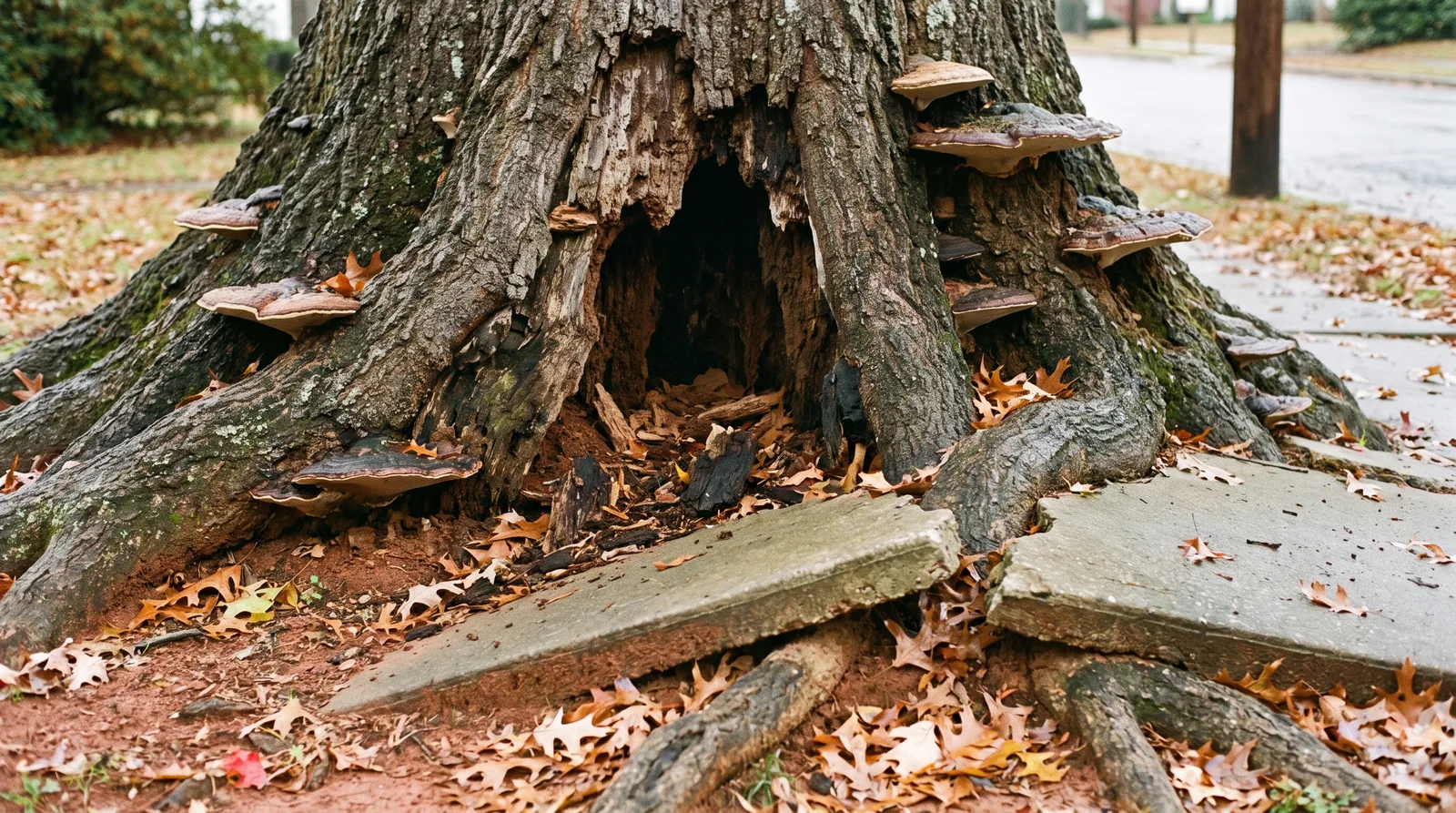
Shelf fungus or mushrooms at the base or on the trunk — conks mean internal decay. A hollow sound when the trunk is tapped. Cavities where old limbs were removed. Carpenter ants streaming in and out of the trunk. Dead limbs in the upper crown while the lower crown looks fine. A sudden limb drop in calm weather. Soil heaving or cracking at the base after wind. Any of these on a water oak over a house is a reason to call an arborist this month, not next year.
What to do about each
Willow oak: keep it. Deadwood out every three to five years, a canopy lift for clearance, structural pruning while it's young, and a cable if it has a heavy codominant union. Don't top it, don't let the builder trench through its roots, and don't pile mulch against the trunk.
Water oak: assess it honestly. A sound water oak with no decay can stay a while with careful pruning and inspection. One with conks at the base, a hollow trunk or limb drop over a target is a removal — and the right time is before the ice storm, when you choose the day and the crew, not after, when you don't.
Replace with the right oak: where a water oak comes out, plant a white oak, willow oak, overcup oak or nuttall oak. Same size in fifty years, and it will still be standing in a hundred.
Common questions
Are water oaks always a problem?
Not always, but they're always short-lived. A 30-year-old water oak in the open is fine. A 70-year-old water oak leaning over a bedroom is a decision that has to be made on evidence, and our arborist's inspection gives you that evidence.
Can you tell if my oak is hollow without cutting it?
Usually. We sound the trunk with a mallet, probe suspect areas, look for conks and cavities, and when it's close we can use a resistance drill to measure the shell of sound wood. A tree can stand with a hollow center if the shell is thick enough — that's a measurement, not a guess.
What about red oaks and white oaks?
Both are excellent. Northern and southern red oaks are strong and long-lived; white oaks are the best of all and can live 300 years. Post oaks and blackjack oaks are common on the older farmsteads east of town and are tough as nails. Keep them all.
Why do water oaks drop limbs on calm days?
It's called summer branch drop — internal stress in decayed or water-stressed limbs on hot, still afternoons. Water oaks and elms are the classic cases. It's a sign the tree needs to be looked at, and an argument for not parking under it in August.
Related: Oak tree service · Cabling & bracing · Tree trimming · Tree removal